Chapter Five
Makkah, the Prophet’s Birthplace ﷺ
The Metropolis
Those unfamiliar with the conditions in Makkah at the time of the Prophet’s birth, or with the social life, history, legends, literature and poetry of Arabia during pre-Islamic times, might imagine Makkah to have been a hamlet with a few tents of goat’s hair scattered hither and thither, surrounded by sheep, horses and camels, and half-clad women and children, within a narrow valley flanked by sharp, jagged hill-tops. They perhaps view the people as ignoble and beggarly, passing through a stage of cultural and intellectual infancy, having no aesthetic sense, polish, or refinement; a people who would subsist on a diet of stale bread and half-baked mutton and wore clothes made of camel’s hair.
Such a poor and miserable depiction of Makkah is inconsistent with the unmistakable landscape of the city emerging from historical records, collections of pre-Islamic poetry, and the habits and customs, norms and traditions of the Arabs. The people of Makkah had already been drawn into the stream of urban culture from their earlier rural, nomadic existence.
To tell the truth, such a vile and mean view of Makkah is not in keeping with the Qur’ānic description of the city, which gives it the name of “the mother of towns”:
At another place, Makkah is designated as the “land made safe”:
And the Qur’ān also calls it a city:
Makkah had, as a matter of fact, already passed from nomadic barbarism to the stage of urban civilization by the middle of the fifth century. The city was ruled by a confederacy based on mutual co-operation, unity of purpose, and a general consensus on the division of administrative and civil functions between self-governing clans, and this system had been brought into existence by Quṣayy ibn Kilāb. As the Prophet Muḥammad ﷺ was fifth in the line of succession from Quṣayy ibn Kilāb, the latter can be placed somewhere in the middle of the fifth century.
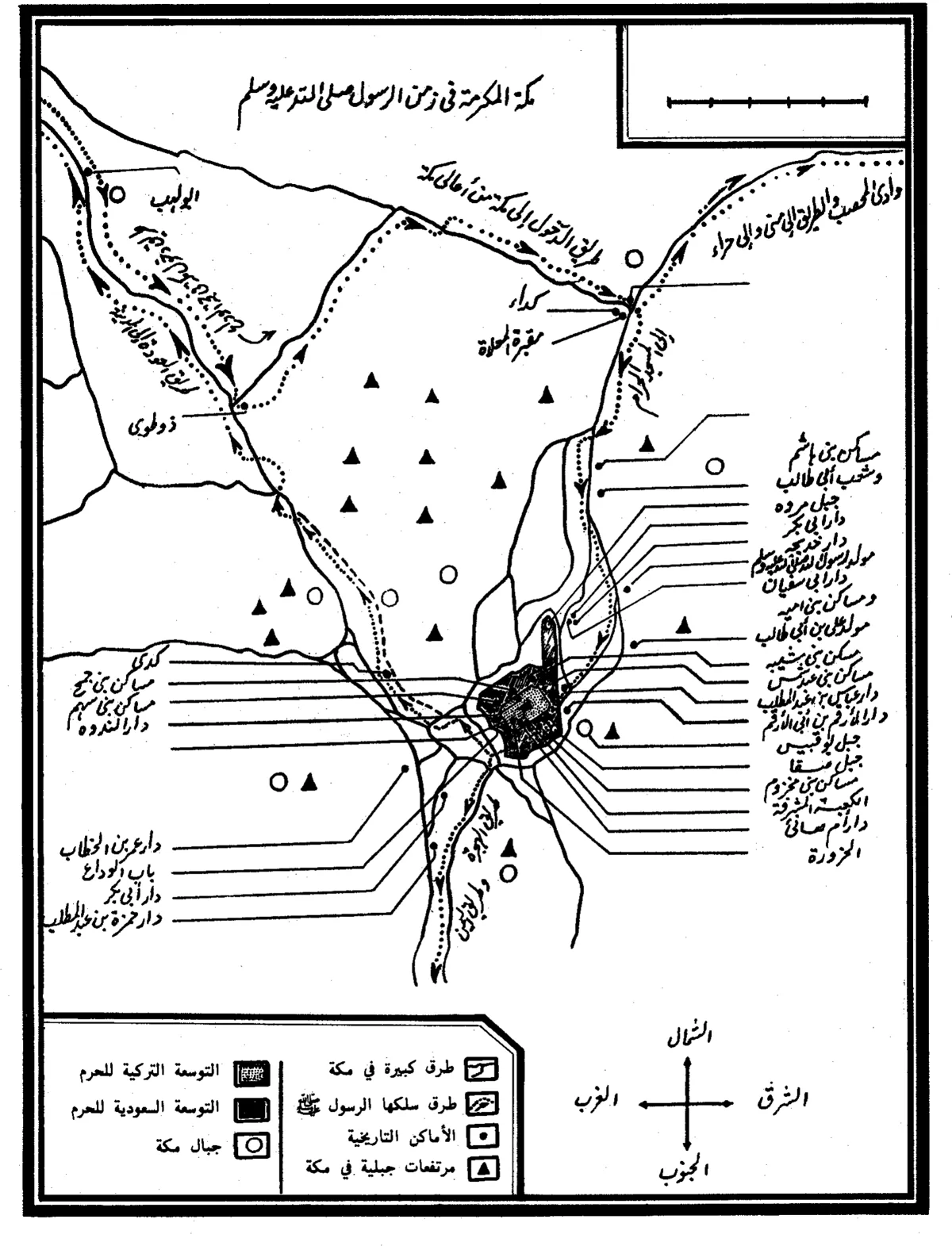
Makkah, thinly populated in the beginning, was located between the two hills called Jabal Abū Qubays (adjacent to Mount Ṣafā) and Jabal Aḥmar, known as A‘raf during the pre-Islamic days, opposite the valley of Qu‘ayqi‘ān. The population of the town increased gradually, owing partly to the reverence paid to the Ka‘bah and the esteemed position of its priests and attendants, and partly because of the peace prevailing in the vicinity of the sanctuary. The tents and shacks had given place to houses made of mud and stones, and the habitation had spread over the hillocks and low-lying valleys around the Ka‘bah. At the outset, the people living in Makkah abstained from constructing even their housetops in a rectangular shape like the Ka‘bah, since they considered it to be a sign of disrespect to the House of God, but gradually those ideas changed. Still, they kept the height of their houses lower than that of the Ka‘bah. As related by certain persons, the houses were initially made in a circular shape as a mark of respect to the Ka‘bah. The first rectangular house, reported to have been built by Ḥumayd ibn Zuhayr, was looked upon with disfavor by the Quraysh.
The chiefs and other well-to-do persons among the Quraysh usually built their houses of stone with many rooms in them, and with two doors on opposite sides, so that the womenfolk were not inconvenienced by the presence of guests.
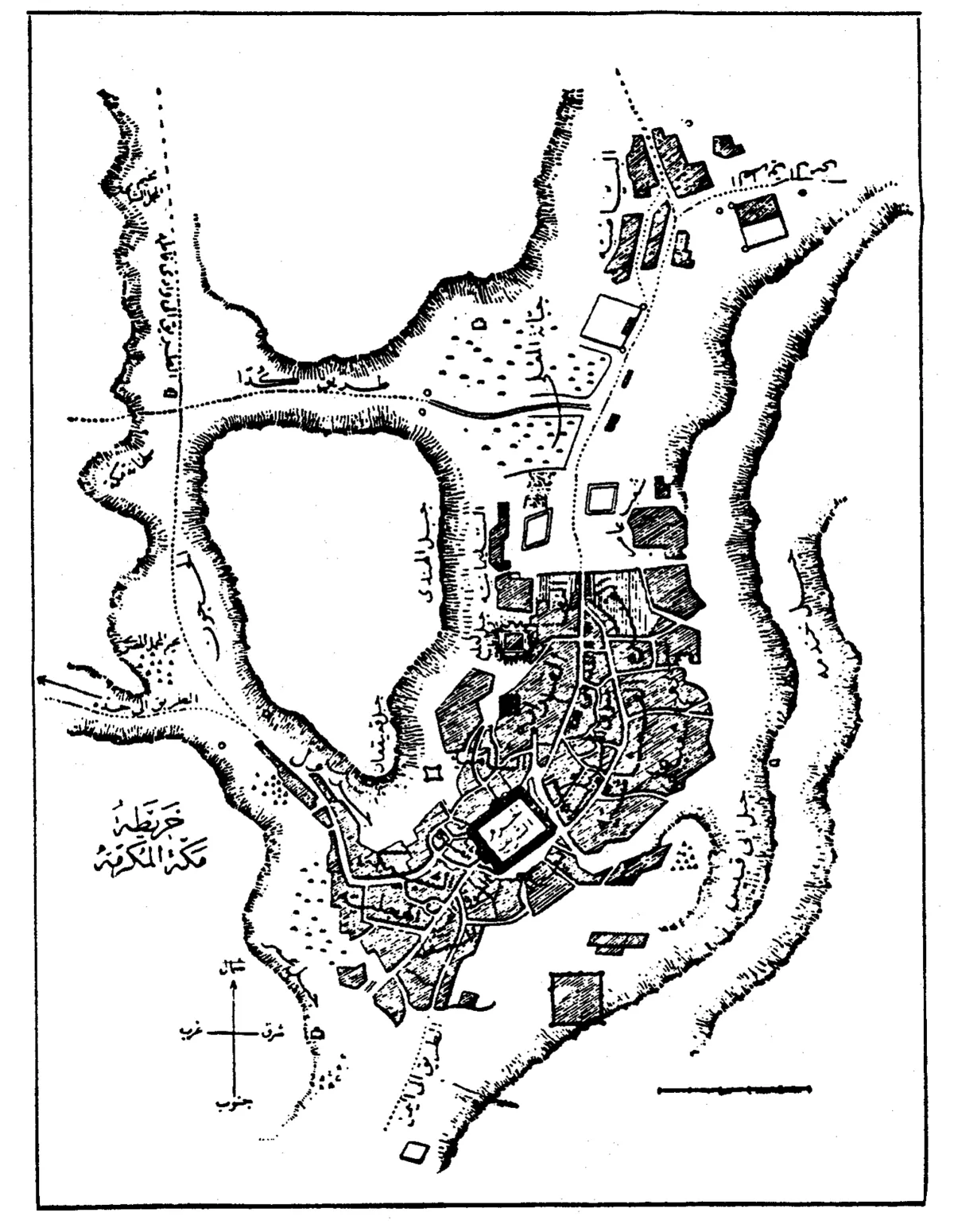
Reconstruction of Makkah
Quṣayy ibn Kilāb had played a leading role in the reconstruction and expansion of Makkah. The Quraysh, who had been dispersed over a wide area, were brought together by him in the valley of Makkah. He allocated areas for the various families to settle in and encouraged them to construct their houses in the specified localities. The successors of Quṣayy continued to consolidate the living quarters and to allocate spare lands to new families coming into Makkah. The process continued peacefully for a long time, with the result that the habitations of the Quraysh and their confederate clans grew, making Makkah a flourishing city.
The City State
Quṣayy ibn Kilāb and his family had assumed a commanding position over the city and its inhabitants. They were the caretakers of the Ka‘bah, had the privilege of Siqāyah,4 or watering the pilgrims, and of arranging the annual feast, presided over the meetings of the House of Assembly (Dār an-Nadwah), and handed out war banners.
Quṣayy ibn Kilāb had built the House of Assembly close to the Ka‘bah, with one of its doors leading to the sanctuary. It was used both as a living quarter by Quṣayy and as a meeting place for discussing all matters of the common weal by the Quraysh. No man or woman got married, no discussion on any important matter was held, no declaration of war was made, and no sheet of cloth was cast on the ‘head’5 of any girl reaching marriageable age except in this house. Quṣayy’s authority during his life and after his death was deemed sacrosanct in the vein of religious injunctions, which nobody could violate. The meetings of the House of Assembly could be attended only by the Quraysh and their confederate tribesmen, that is, those belonging to Hāshim, Umayyah, Makhzūm, Jumaḥ, Sahm, Taym, ‘Adī, Asad, Nawfal, and Zuhrah, whatever their age, while people of other tribes above the age of forty years were allowed to participate in its meetings.
After the death of Quṣayy, the offices he had held were divided between different families. Banū Hāshim were given the right of watering the pilgrims; the standard of Quraysh, called ‘Uqāb,6 went to Banū Umayyah; Banū Nawfal were allocated the Rifādah;7 Banū ‘Abd ad-Dār were assigned the priesthood, the wardenship of the Ka‘bah, and the standard of war; and Banū Asad had charge of the House of Assembly. These families of the Quraysh used to entrust these responsibilities to notable persons belonging to their families. Thus Abū Bakr, who came from Banū Taym, was responsible for releasing blood money, fines and gratuities; Khālid, of Banū Makhzūm, held charge of the apparatus of war, kept in a tent during peace-time and on horseback during battles; ‘Umar ibn al-Khaṭṭāb was sent as the envoy of Quraysh to other tribes with whom they intended to measure swords, or where a tribe bragging of its superiority wanted the issue to be decided by a duel; Ṣafwān ibn Umayyah, of Banū Jumaḥ, played at the dice,8 which was deemed essential before undertaking any important task; and Ḥārith ibn Qays was charged with performing all administrative business, besides being the custodian of offerings to the idols kept in the Ka‘bah. The duties allocated to these persons were hereditary offices held formerly by their forefathers.
Commercial Operations
The Quraysh of Makkah used to fit out two commercial caravans: one to Syria during the summer and the other to Yemen during the winter season. The four months of Ḥajj, that is, Rajab, Dhu ’l-Qa‘dah, Dhu ’l-Ḥijjah, and Muḥarram, were deemed sacred, during which it was not lawful to engage in hostilities. During these months, the precincts of the holy temple and the open place beside it were utilized as a trade center where people from distant places would gather to transact business. Everything the Arabs required was easily available in the market of Makkah. The stores for the sale of various commodities were located in designated lanes and byways, as mentioned by the historians, indicating the economic and cultural growth of Makkah. The perfume vendors had their stalls in a separate lane, as did the fruit-sellers, barbers, grocers, vendors of fresh dates, and other wares and trades, each localized in different alleys. A number of these markets were spacious; for example, the grain market was well stocked with wheat, ghee (clarified butter), honey, and the like. All these articles were brought by trading caravans. To cite an instance, wheat was brought to Makkah from Yamāmah.9 Similarly, cloth and shoe stores had separate quarters allocated to them in the market.
Makkah also had a few meeting places where carefree young men used to come together for diversion and leisure. Those who were prosperous and accustomed to living well spent the winter in Makkah and the summer in Ṭā’if. There were even some smart young men known for their costly and trim dress, which would amount to several hundred dirhams.
Makkah was the center of a lucrative trade, transacting business on a large scale. Its merchants sent caravans to different countries in Asia and Africa and imported almost all the necessities and costly wares marketable in Arabia. They usually brought resin, ivory, gold, and ebony from Africa; hide, myrrh, frankincense, spices, sandalwood, and saffron from Yemen; various oils and grains, armor, silk, and wines from Egypt and Syria; cloth from Iraq; and gold, tin, precious stones, and ivory from India. The wealthy merchants of Makkah sometimes presented the products of their city, of which the most valued were leather products, to the kings and nobles of other countries. When Quraysh sent ‘Abdullāh ibn Abī Rabī‘ah and ‘Amr ibn al-‘Āṣ to Abyssinia to bring back the Muslim fugitives, they sent with them leather goods of Makkah as gifts to the Negus and his generals.
Women also took part in commercial undertakings and fitted out their own caravans bound for Syria and other countries. Khadījah bint Khuwaylid and al-Ḥanẓaliyyah, mother of Abū Jahl, were two merchant women of dignity and wealth. The following verse of the Qur’ān attests the freedom of women to ply a trade:
Like other advanced nations of that age, the commercially minded citizens of Makkah had based their economy on commerce, for which they sent out caravans in different directions, organized stock markets, and created favorable conditions in the home market for visiting tourists and traders. This helped to increase the fame and dignity of Makkah as a religious center and contributed in no mean measure to the prosperity of the city. Everything required by the people of Makkah, whether a necessity or a luxury, reached their hands because of the city’s commercial importance. This fact finds a reference in these verses of the Qur’ān:
Economic Conditions, Weights and Measures
Makkah was thus the chief center of big business in Arabia, and its citizens were prosperous and wealthy. The caravan of Quraysh involved in the battle of Badr, while returning from Syria, consisted of a thousand camels and carried merchandise worth 50,000 dinars.12
Both the Byzantine and Sasanian currencies, known as dirham and dinar, were in general use in Makkah and other parts of the Peninsula. The dirham was of two kinds: one was an Iranian coin known to the Arabs as baghliyyah and Sarda dāmiyyah, and the other was a Byzantine coin (Greek drachma), which was called ṭabriyyah and Bizanṭiyyah. These were silver coins, and therefore, instead of using them as units of coinage, the Arabs reckoned their values according to their weight. The standard weight of a dirham, according to the scholars of Islamic Sharī‘ah, was equal to fifty-five grains of barley, and ten dirhams were equivalent in weight to seven mithqāls of gold. One mithqāl of pure gold was, however, according to Ibn Khaldūn, equal to the weight of seventy-two grains of barley. The legal scholars unanimously agree with the weight standard of Ibn Khaldūn.
The coins in current use during the time of the Prophet were generally silver coins. ‘Aṭā’ states that the coins in general use during the period were not gold but silver coins.13 The dinar was a gold coin, familiar to the Arabs as the Roman (Byzantine) coin in circulation in Syria and Ḥijāz during the pre-Islamic and early Islamic period. It was minted in Byzantium with the image and name of the Emperor impressed on it, as stated by Ibn ‘Abd al-Barr in al-Tamhīd. Old Arabic manuscripts mention the Latin denarius aureus as the Byzantine coin (synonymous with the post-Constantine solidus), which is stated to be the name of a coin that was still a unit of currency in the former Yugoslavia. The New Testament, too, mentions the denarius in several places. The dinar was considered to have the average weight of one mithqāl, which, as stated above, was equivalent to seventy-two grains of barley. It is generally believed that the weight standard of the dinar was maintained from pre-Islamic days down to the fourth century of the Hijrah. The Dā’irat al-Ma‘ārif al-Islāmiyyah says that the Byzantine denarius weighed 4.25/4.55 grams and hence, according to the Orientalist Zambaur, the mithqāl of Makkah was also of 4.25/4.55 grams.14 The ratio of weight between the dirham and the dinar was 7:10, and the former weighed seven-tenths of a mithqāl. The caliph ‘Abd al-Malik ibn Marwān reduced the mithqāl during his reign to 4.25 grams.
The par value of the dinar, deduced from the ḥadīth, fiqh,15 and historical literature, was equivalent to ten dirhams. ‘Amr ibn Shu‘ayb, as quoted in the Sunan of Abū Dāwūd, relates: “Blood money during the time of the Prophet was 800 dinars or 8,000 dirhams, which the Companions of the Prophet followed, and the entire Muslim community unanimously agreed to retain it.” Authentic ḥadīths fix the niṣāb, or the amount of property upon which zakāt16 is due, at 200 dirhams, or 20 dinars. This rule, upheld by a consensus of the doctors of law, goes to show that during the earlier period of the Islamic era, and even before it, a dinar was deemed to have a par value of ten dirhams or other coins equivalent to them.
Imām Mālik says in the Muwaṭṭa’ that ‘the accepted rule, without any difference of opinion, is that zakāt is due on 20 dinars or 200 dirhams’.17
The weights and measures in general use in those days were the ṣā‘, mudd, riṭl, ūqiyah, and mithqāl, to which a few more were added later on. The Arabs also possessed knowledge of arithmetic, for it is evident that the Qur’ān relied on their ability to compute the shares of the legatees in promulgating the Islamic law of inheritance.
Prosperous Families of Quraysh
Banū Umayyah and Banū Makhzūm were the two prominent families of the Quraysh favored with an abundance of wealth, prosperity, and comfortable living. Walīd ibn al-Mughīrah, ‘Abd al-‘Uzzā (Abū Lahab), Abū Uḥayḥah Sa‘īd ibn al-‘Āṣ ibn Umayyah (who had a share of 30,000 dinars in the caravan of Abū Sufyān), and ‘Abd ibn Abī Rabī‘ah al-Makhzūmī had made good fortunes. ‘Abdullāh ibn Jud‘ān of Banū Taym was also one of the wealthiest persons of Makkah; he used to drink water from a cup of gold and maintained a public kitchen for providing food to every poor person and beggar. ‘Abbās ibn ‘Abd al-Muṭṭalib was another man abounding in riches, who spent lavishly on the indigent and the needy and lent money at interest in Makkah. During his Farewell Pilgrimage, when the Apostle abolished usurious transactions, he declared: ‘The first usury I abolish today is that of ‘Abbās ibn ‘Abd al-Muṭṭalib.’ Makkah also had men rolling in riches whose well-furnished drawing rooms were the rendezvous of the elite of the Quraysh, who rejoiced in the pleasures of wine, love, and romance.
The chiefs of Quraysh usually had their sittings in front of the Ka‘bah, where prominent poets of pre-Islamic days, such as Labīd, recited their poems. It was here that ‘Abd al-Muṭṭalib used to have his gatherings and, as they say, his sons dared not take their seats around him until their father had arrived.
Culture and Arts
The Quraysh looked down upon industrial arts and crafts, considering it beneath their dignity to engage in manual labor. Manual occupations were regarded as tasks reserved for slaves or non-Arabs. Notwithstanding this prejudice of the Quraysh, certain crafts were a dire necessity, and some would practice them. Khabbāb ibn al-Aratt is reported to have engaged in manufacturing swords. Construction activities were also indispensable, but the Quraysh would employ Iranian and Byzantine workmen to do the job for them.
A few men in Makkah knew the art of reading and writing, but the Arabs, as a whole, were ignorant of the means by which learning is imparted. The Qur’ān also calls them Ummī,18 or an unlettered people:19
The people of Makkah were, however, not unsophisticated. Their refined taste, polish, and culture made them excel in all Arabia, in the same way as the townsmen of any metropolis occupy a distinctive place in their country.
The language spoken in Makkah was regarded as a model of unapproachable excellence. The Makkan dialect set the standard that the desert Bedouins, as well as the Arabs of outlying areas, strove to imitate. By virtue of their elegant expression and eloquence, the inhabitants of Makkah were considered to possess the finest tongue, uncorrupted by the grossness of the languages of non-Arabs. In their physical features, shapeliness, and good looks, the people of Makkah were considered to be the best representatives of the Arab race. They were also endowed with the virtues of courage and magnanimity of heart, acclaimed by the Arabs as al-futuwwah (chivalry) and al-murū’ah (manliness), the two oft-repeated themes of Arab poetry. These traits of their character admirably describe their recklessness, which savored both of a devil and a saint.
The matters that attracted their attention most were genealogy, the legends of Arabia, poetry, astrology and the planetary mansions, the ominous flight of birds, and a little medicine. As expert horsemen, they possessed an intimate knowledge of the horse and preserved the memory of the purest breeds; and as dwellers of the desert, they were well versed in the delicate art of physiognomy. Their therapy, based partly on their own experience and partly on the traditional methods handed down to them from their forefathers, consisted of branding, phlebotomy, removal of diseased limbs, and the use of certain herbs.
Military Prowess
The Quraysh were, by nature or nurture, a peace-loving people, amiable in disposition; for, unlike all other peoples inside and outside the Peninsula, their prosperity depended on the development of free trade, the continual movement of caravans, the improvement of market facilities in their own city, and the maintenance of conditions peaceful enough to encourage merchants and pilgrims to bend their steps to Makkah. They were sufficiently farsighted to recognize that their mercantile business was their life: trade was the source of their livelihood as well as the means to increase their prestige as servants of the sanctuary. The Qur’ān has also referred to this fact in Sūrah Quraysh:
In other words, they were inclined to avoid a struggle unless their tribal or religious honor was in peril. They were thus committed to the principle of peaceful coexistence; nevertheless, they possessed considerable military prowess. Their courage and intrepidity were as renowned throughout Arabia as was their skill in horsemanship. Al-Ghaḍabah al-Muḍariyyah, or “the wrath of the Muḍar”, was a well-known adage in the Arabic language, frequently used by the poets and orators of pre-Islamic Arabia. It was described as a tormenting thirst quenched by nothing save blood.
The military prowess of Quraysh was not restricted to their own tribal reserves alone. They utilized the services of the Aḥābīsh, or the desert Arabs living around Makkah, some of whom traced their descent to Kinānah and Khuzaymah ibn Mudrikah, distant relations of Quraysh. The Khuzā‘ah were also confederates of the Quraysh. In addition, Makkah had always had slaves in considerable numbers who were ever willing to fight for their masters. They could thus draft, at any time, several thousand warriors under their banner. In the battle of Aḥzāb, Quraysh enlisted the strongest force ever mustered in the pre-Islamic era, numbering ten thousand combatants.
Makkah, the Heart of Arabia
By virtue of its position as the seat of the national shrine and a flourishing commercial center with cultured inhabitants, Makkah had secured a pre-eminent position in Arabia. It was considered a rival of Ṣan‘ā’ in Yemen, but with the Abyssinians and Iranians gaining control over Ṣan‘ā’, one after another, and the decline of the earlier glamour of Ḥīrah and Ghassān, Makkah had attained a place of undisputed supremacy in Arabia.
The Moral Life
A moral ideal was what the Makkans lacked most of all; or one can say that, except for the binding force of some stale customs and the traditional sentiments of Arab chivalry, they had no code of ethics to guide their conduct. Gambling was a favorite pastime in which they took pride, unrestrained drunkenness sent them into rapturous delight, and immoderate dissipation satisfied their perverted sense of honor. Their gatherings were scenes of drinking bouts and wanton debauchery. Without any idea of sin or crime, they never gained an aversion to wickedness, iniquity, callousness, and brigandage.
The moral atmosphere of Arabia in general, and of Makkah in particular, was faithfully depicted by Ja‘far ibn Abī Ṭālib, a prominent member of the Quraysh, at the court of the Negus, when he said to him: “O King, we were an unenlightened people plunged in ignorance. We worshipped idols, we ate carrion, and we committed abominations; we broke natural ties, we ill-treated our neighbors, and our strong devoured the weak.”22
Religious Life
The religious practices and beliefs of the Arabs were, beyond doubt, even more despicable, particularly by reason of the influence they exerted on the social and moral life of the people. Having lost all but a little touch with the wholesome teachings of the prophets of old, they had been completely submerged in the crude and materialistic form of fetishism like that prevailing in the countries surrounding them. So fond had they become of idol worship that no fewer than three hundred and sixty deities adorned, or rather defiled, the holy sanctuary. The greatest amongst these gods was Hubal, whom Abū Sufyān had extolled at the battle of Uḥud when he cried out: “Glory be to Hubal!” The idol occupied a central place in the Ka‘bah, by the side of a well in which the offerings were stored. Sculptured in the shape of a man, it was made of a huge cornelian rock. As its right hand was missing when Quraysh discovered it, they had replaced it with a hand made of solid gold. Two idols had been placed in front of the Ka‘bah. One was called Isāf and the other Nā’ilah; the former had been installed close to the Ka‘bah and the latter by the site of Zamzam. After some time, the Quraysh shifted the first one closer to the other, where they offered up sacrifices beside them. On the mounts of Ṣafā and Marwah, there were two more idols, called Nahīk Mujāwid ar-Rīḥ and Muṭ‘im aṭ-Ṭayr.
Every household in Makkah had an idol which they would worship. Al-‘Uzzā had been installed near ‘Arafāt within a temple constructed for it. Quraysh venerated al-‘Uzzā as the chief or the noblest of all deities. The Arabs would cast lots with the help of divining arrows placed before these idols in order to make a decision to commence any affair. There were also other idols. One, named al-Khalṣah, had been set up in the depression of Makkah’s valley. This idol was garlanded, presented with offerings of barley and wheat, and bathed with milk. The Arabs used to make sacrifices and hang ostrich eggs over it. Replicas of this popular deity were sold by vendors to the villagers and pilgrims visiting Makkah.
The Arabs possessed the virtues of courage, loyalty and generosity, but during the long night of superstition and ignorance, the worship of images and idols had stolen into their hearts, perhaps more firmly than in any other nation; and they had wandered far away from the simple faith of their ancestors Ibrāhīm and Ismā‘īl, which had once taught them the true meaning of religious piety, purity of morals and seemliness of conduct.
So this was the city of Makkah, by the middle of the sixth century of the Christian era, before the birth of the Prophet, whence we see Islam rising on a horizon shrouded in obscure darkness. In truth, the Lord has said:
Notes
- 1Qur’ān 42:7.
- 2Qur’ān 95:1–3.
- 3Qur’ān 90:1–2.
- 4Water supplied to the pilgrims was stored in specially constructed tanks; the water was sweetened by mixing in dates and raisins.
- 5A large piece of cloth with an opening cut through it, through which the girl could put her head, was placed over her to signify her betrothal.
- 6Lit. “eagle”.
- 7A tax paid by Quraysh from their property for providing food to the pilgrims (al-Khuḍarī, p. 36).
- 8Dice marked “yes” and “no” on either side were thrown to decide whether any important task was to be undertaken or not. It was known as al-aysar wa ’l-azlām.
- 9When Thumāmah ibn Uthāl (the chief of Banū Ḥanīfah) embraced Islam, he put a ban on the export of wheat to Makkah. The Quraysh found this so irksome that they had to make a request to the Prophet, at whose intervention Thumāmah raised the ban. Zād al-Ma‘ād, vol. 1, p. 377; Muslim also relates the same in his Ṣaḥīḥ.
- 10Qur’ān 4:32.
- 11Qur’ān 106:3–4.
- 12Strabo once saw an Arabian caravan arriving at Petra and likened it to an army (Arabia Before Muhammad, p. 185).
- 13Ibn Abī Shaybah, al-Muṣannaf, vol. 3, p. 333.
- 14Vol. IX, p. 270, art. “Dīnār”.
- 15Jurisprudence: the science of law covering devotional ritual, private conduct, and dealings, as well as the civil and criminal law of Islam.
- 16Lit. ‘purification’; hence a specified portion of property one is obliged to give over, either privately or to the State, as alms, for the sanctification of the remainder.
- 17Bulūgh al-Arab fī Ma‘rifat Aḥwāl al-‘Arab by Ālūsī, al-Tarātīb al-Idāriyyah by ‘Abd al-Ḥayy al-Kattānī, Fiqh az-Zakāt by Yūsuf al-Qaraḍāwī, and Tafsīr Mājidī by ‘Abd al-Mājid Daryābādī.
- 18Lit. “the unlettered”; also a title of the Prophet. For a detailed discussion of the subject, see the article “Was Muhammad Literate?” by Mohiuddin Ahmad in Islam and the Modern Age, vol. VIII, no. 2 (May 1977).
- 19Balādhurī lists 17 individuals who alone knew how to read and write in Makkah (Futūḥ al-Buldān, Leiden, pp. 471–472).
- 20Qur’ān 62:2.
- 21Qur’ān 106:3–4.
- 22Ibn Hishām, vol. 1, p. 335.
- 23Qur’ān 36:6. Besides ḥadīth and tafsīr, help has also been taken in writing this section from Kitāb al-Aṣnām by Ibn al-Kalbī (d. 204 AH), Sīrat Ibn Hishām (d. 213 AH), Akhbār Makkah by Imām Abu ’l-Walīd Muḥammad al-Azraqī (d. 223 AH), Bulūgh al-Arab fī Ma‘rifat Aḥwāl al-‘Arab by Sayyid Maḥmūd Shukrī al-Ālūsī (d. 1342 AH), Tārīkh Makkah by Aḥmad al-Sibā‘ī, and Makkah wa ’l-Madīnah fi ’l-Jāhiliyyah wa ‘Ahd ar-Rasūl by Ibrāhīm al-Sharīf.